


Update(1150ET): A US-led naval coalition is finally coming together to protect international shipping transit in the Red Sea and vital Bab al-Mandab Strait, per a breaking development from Politico’s chief Pentagon correspondent: “The Pentagon is expected to announce tomorrow the formation of Operation Prosperity Guardian, a new task force to protect shipping from Houthi attacks in the Bab Al-Mandeb Strait and Red Sea, per DOD official,” writes Lara Seligman on X.
“The operation will be within the framework of the existing Combined Maritime Force 153, a partnership of 39 nations focused on counter piracy and counter terrorism in the Red Sea.”
Soon after this reporting, Defense Secretary Lloyd Austin said, “I am announcing the establishment of Operation Prosperity Guardian, an important new multinational security initiative under the umbrella of the Combined Maritime Forces and the leadership of its Task Force 153, which focuses on security in the Red Sea.”
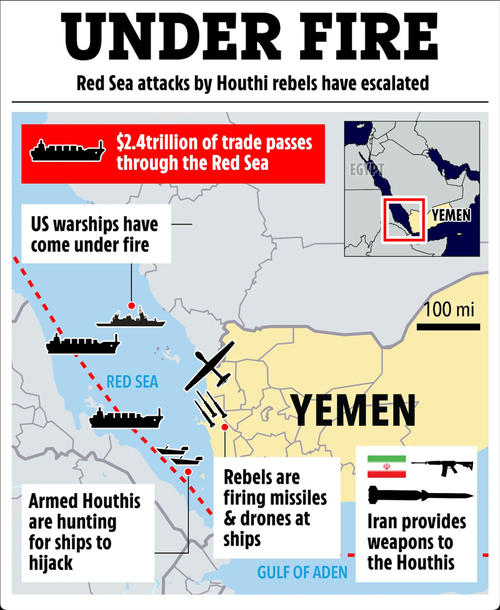
Days ago it was reported that the Pentagon was looking to cobble together the ‘broadest possible’ coalition task force, amid what’s now become daily Iran-backed Houthi attacks on commercial vessels. The Houthis have also launched rockets and drones into southern Israel at various times, triggering US warship intercepts.
Just hours ago, we reminded readers of Zoltan Poszar’s prediction of central-bank-analogized ‘military protection’ and said it’s soon to become a reality… and just like that, it has:
Protection is a conceptual counterpart to par. When you decide to take money out of a sight deposit, you expect the same amount back that you put in (par).
When you sail foreign cargo from port A to port B, you expect to unload the same amount of cargo that you onloaded.
Banks can deliver par on deposits most of the time. When not, central banks step in to help.
Commodity traders can deliver foreign cargo from port A to port B most of the time, but when not, the state intervenes again: not the monetary arm, but the military arm of the state.
What central banks are to the protection of par promises, the military branch is to the protection of shipments: foreign cargo needs to sail on sea routes and through choke points like the Strait of Hormuz, and “par” in this context means being able to sail from here to there freely, safely, and without undue delays…
It has also emerged that Australia is expected to play a major role in Red Sea operations in the context of deepening ties with the US related to the AUKUS deal.
Suez update: 46 container ships now have diverted around the Cape of Good Hope rather than transiting the Red Sea. pic.twitter.com/4zaTXn3LO1
— Ryan Petersen (@typesfast) December 18, 2023
U.S. IKE carrier & BATAAN amphibious group are en-route to Yemen in support of a potential response to the Houthi attacks 😬 https://t.co/HvMlx5uk5G pic.twitter.com/9OawW6jWJW
— Financelot (@FinanceLancelot) December 18, 2023
Rabobank explains in the following…
Australia is reportedly in talks with the Pentagon over a US request to send an Australian warship to the Red Sea to assist in dealing with Iran-backed Houthi rebels, who have been disrupting commercial shipping in the region and launching missile and drone strikes against US targets and their allies. This request comes just days after Congress passed laws enabling the sale of Virginia class submarines to Australia under the terms of the AUKUS pact.
The agreement marks just the second time that the United States has shared nuclear secrets with another country (on purpose, at least), so it appears that there is an element of “I scratch your back, you scratch mine” going on here. This is not without its complications, as many members of Australia’s political establishment (particularly within the ruling Labor Party) still cling to dreams of ‘strategic autonomy’ of the kind that doesn’t even work for Europe.
Their fear is that AUKUS, and an Australian warship shooting down drones in the Red Sea, further locks Australia in as an organ of US foreign policy, which it probably does. But really, this is par for the course and probably just the modern incarnation of Australia’s long-running policy of having ‘great and powerful friends’. Quite aside from the diplomatic horse-trading that accompanies it, disruption of shipping in the Red Sea is a big problem, and Europe has the most to lose. 150 years of supply chain improvement risks being unwound as major shipping companies redirect vessels around the Cape of Good Hope to avoid traversing the region to pass through the Suez Canal into the Mediterranean.
* * *
Amid further attacks and reroutings…
U.S. warships currently operating in the Red Sea https://t.co/iUnBov1hkR pic.twitter.com/bqNwlDq18M
— Financelot (@FinanceLancelot) December 18, 2023
…we look at the true scale of the Houthi attacks on MidEast tankers.
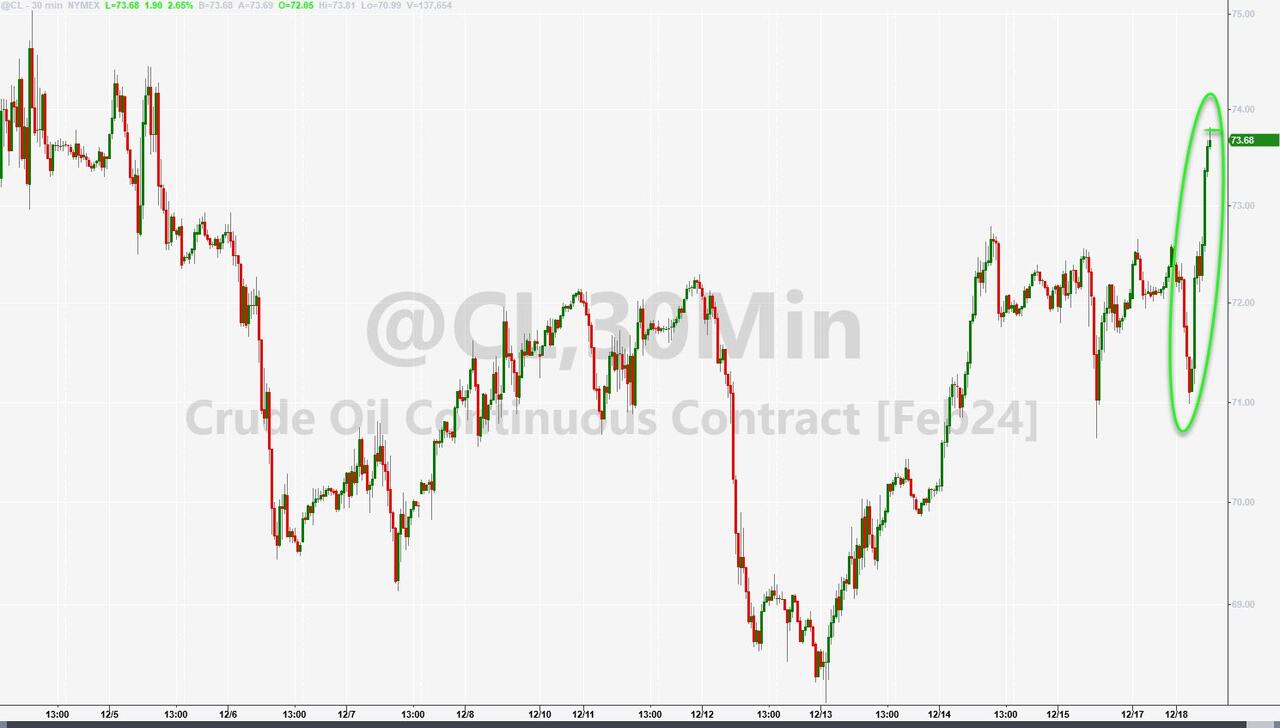
Oil prices are rising…
And given the extreme positioning in managed money…
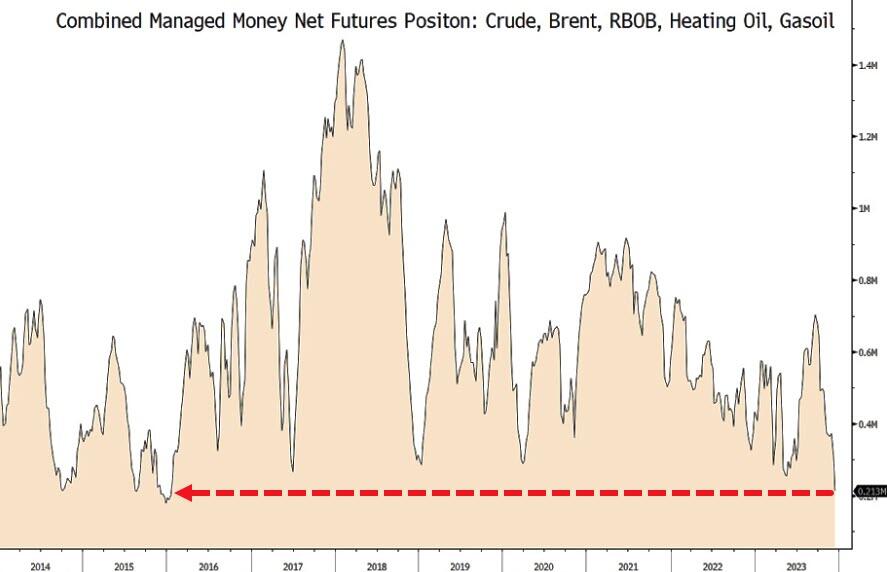
And CTAs swinging short…

We suspect the market is underestimating the impact that S&P Global’s Jennifer Gnana, Kelly Norways, and Mohammed Al-ansare detail below,
-
Cape transport option adds 40% to voyage distance
-
Houthis targeting tankers, container, cargo shipping
-
Container rates rise to 2023 high
Major shipping companies paused transiting the Middle East’s critical Bab al-Mandeb chokepoint for seaborne trade Dec. 15 after repeated attacks by Yemen’s Houthi militants threatened to upend global trade flows. Read more here…