
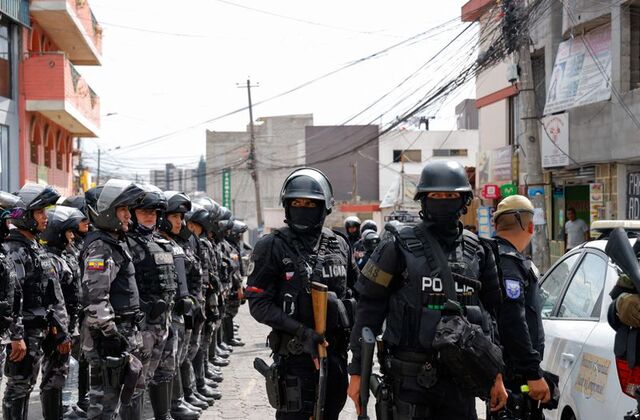

Armed gunmen wearing masks stormed a television station in Ecuador’s largest city on Tuesday, taking anchors and staff hostage and exchanging gunfire with the police as cameras rolled before the intruders were subdued and arrested.
The televised violence, captured live, erupted in the city of Guayaquil as the South American country has descended into chaos this week, with a powerful gang leader disappearing from prison, uprisings breaking out in several prisons and inmates kidnapping and threatening guards.
One of the attackers who stormed the TV station could be heard on the air asking to be wired up with a microphone, saying he intended to send a message about the consequences of “messing with the mafias.” Before he could, the police intervened. The armed men also forced the anchors and other staff being held hostage to appear in a video asking the president not to interfere.
The police said on social media that they had arrested 13 people after the episode, recovering “weapons, explosives and other evidence.” The hostages were also released safely, the post said.
By Tuesday afternoon, at least eight people had died and two others had been injured in violent episodes in Guayaquil, according to the city’s mayor, Aquiles Álvarez, who held a news conference alongside the chief of police. The authorities also said five hospitals had been overtaken.
Explosions, burning vehicles, looting and gunfire were also reported across the country, and the authorities announced that a second major gang leader and other inmates had escaped from another prison.
Ecuador’s president, Daniel Noboa, declared an internal armed conflict on Tuesday and ordered the armed forces to “neutralize” two dozen gangs, which he described as “terrorist organizations,” according to a post on X, formerly known as Twitter.
Shops, schools, government offices and buildings were shut down. Workers were sent home, and streets in Quito and Guayaquil were jammed with traffic.
“It was chaotic, as you can imagine,” said Carolina Valencia, who was visiting family in Guayaquil from New York. “There was traffic everywhere because people just wanted to get home. The buses weren’t fully operating, so people were jumping on the pickup trucks that are open in the back.”
“There was a lot of desperation,” she added. “Since this gangster disappeared, everyone has been in constant fear.”
Mr. Noboa, who has prioritized restoring security to a country awash in gang violence fueled by a flourishing drug trade, had earlier declared a state of emergency and deployed more than 3,000 police and military officers to search for the escaped gang leader, Adolfo Macías.
The 60-day declaration imposes a nationwide overnight curfew and allows the military to patrol the streets and take control of the prisons.
“The time is over when drug-trafficking convicts, hit men and organized crime dictate to the government what to do,” Mr. Noboa said in a video announcing the state of emergency on Monday, adding that it was necessary for security forces to take control of Ecuador’s prison system.
Mr. Macías, who is the head of Los Choneros gang and is better known as “Fito,” disappeared on Sunday from an overcrowded prison in the coastal city of Guayaquil, from which he has long overseen his group’s operations.
The government had ordered the transfer of high-profile convicts, including Mr. Macías, from the cells where they have been running their criminal rings to a maximum-security facility. That decision, prison experts said, may have led to the escape of Mr. Macías and the prison uprisings.
Some security experts believe that as many as one-fourth of the country’s 36 prisons are controlled by gangs. Mr. Noboa has vowed to retake control of the prisons, which have become both gang headquarters and recruiting centers.
Last week, he announced that he was seeking to hold a referendum on security measures, including harsher sentences for crimes like murder and arms trafficking, and expanding the role of the military.
Mr. Noboa, the center-right scion of a banana dynasty, took office in November after an election dominated by worries about safety and the economy. Violence has spiraled in recent years as gangs have battled for control of lucrative drug-trafficking routes that transport narcotics to the United States and Europe.
Those fears were amplified by the assassination on the campaign trail of another presidential candidate, Fernando Villavicencio, who had said not long before his killing that he had been under threat from Los Choneros.
Mr. Macías is perhaps the most well known of the gang leaders running drug operations from behind bars, and his group is believed to have been one of the first in Ecuador to forge ties with powerful Mexican cartels.
Mr. Macías, who is serving a 34-year sentence for crimes that include drug trafficking, escaped from prison once before, in 2013. He became the leader of Los Choneros around 2020 and presided over the gang’s activities from his cell in the Guayaquil prison, part of a compound that holds around 12,000 inmates. CONTINUE READING HERE….