

The “Devil Comet” will reach peak brightness this weekend as it passes near the sun.
The comet, also known as 12P/Pons-Brooks, visits the inner solar system every 71 years and will reach perihelion — the point in its elliptical orbit when it’s closest to the sun — on Sunday (April 21), appearing bright enough to possibly be seen by the naked eye.
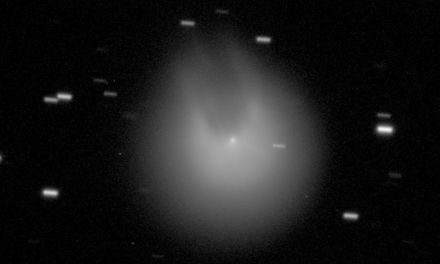
This rarely-seen comet has exhibited occasional outbursts during its journey, creating a horned-like appearance that has earned the comet various nicknames including “Devil Comet” and “Millennium Falcon.” These outbursts are fueled by dust, rock and ices that are heated by the sun and turned into gas, which has formed the glowing horned-shaped halo around the comet, also known as a coma.

The 10.5-mile-wide (17 kilometers) comet is on a trajectory that will bring it about 72.6 million miles (116.8 million km) from the sun during its closest approach. This means Comet 12P will be most visible from Earth a few nights before and after reaching perihelion, when it’s at its brightest and viewers might have the chance to see it without any equipment. Here’s how:
Viewers in the mid- to southern latitudes of North America can look toward the Taurus constellation immediately after sunset to spot the comet. It will be just below the constellation, with the prominent ‘V’ shape of Taurus pointing down towards it.
To see the comet this weekend look to the West in the 90 minutes after sunset, the comet should be below and to the left of Jupiter . The comet will appear low in the west after sunset, setting below the horizon around 90 minutes after the Sun does.
‘This means it will be difficult to observe, but not impossible. It will be just below and to the left of Jupiter, which will appear as a bright white dot to the naked eye.
Although the comet will be at its brightest, it may still be quite hard to see as the lighter evenings reduce its visibility.
Look for a circular, wispy patch of light with possibly a faint tail that stretches up and to the left of the bright central area, or coma, that surrounds the comet’s nucleus.

An illustration of the night sky on April 21, 2024 showing comet 12P/Pons-Brooks below the Taurus constellation. (Image credit: TheSkyLive.com)
There is a chance that it might be visible to the unaided eye in dark areas with clear skies, but a small telescope or binoculars will certainly allow you to spot Comet 12P if conditions are right in your area.
Unfortunately, observers in northern latitudes may struggle to see the comet because it will be positioned in the glow of sunset.
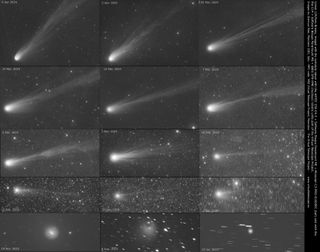
A mosaic of photographs taken by the Virtual Telescope Project near Rome, Italy, over three months in 2024. The change in orientation of the tail over time is accurate, as the camera orientation remains the same in each photo. (Image credit: Gianluca Masi/The Virtual Telescope Project)
If the comet has one of its outbursts during its close approach of the sun, it would experience a period of brightening that could make it easier to observe without a telescope or binoculars.
Shortly after this weekend’s perihelion, Comet 12P will make its closest approach to Earth on June 2, but by that time, it will only be visible in the Southern Hemisphere.