

In a recent report by Ana Maria Mihalcea, MD, PhD, “Hydrogel Platform Enables Versatile Data Encryption And Decryption” – The Next Programmable Human Machine Interface Is “Smarter” Than You Think, she details the hydrogel platform being found in the blood enables versatile data encryption and decryption that is programmable.
WATCH: Hydrogels in COVID Vaccine as Programmable Human Interface – Greg Reese Report
WATCH: Evidence Shows Biological ID System Has Already Been Deployed – Greg Reese Report
Here are her findings:
Hydrogels can now be programmed, encrypted and decrypted. We know that hydrogel is the substrate of the brain computer interface and the modality of fusing humans with machines as described previously in the MIT article linked below. One of the hydrogels used for this encryption modality is polyvinyl alcohol. That was the polymer that Clifford Carnicom and I found via Near Infrared spectroscopy in the hydrogel/CDB/Morgellons/advanced nanotechnology filaments in C19 vaccinated and unvaccinated blood.
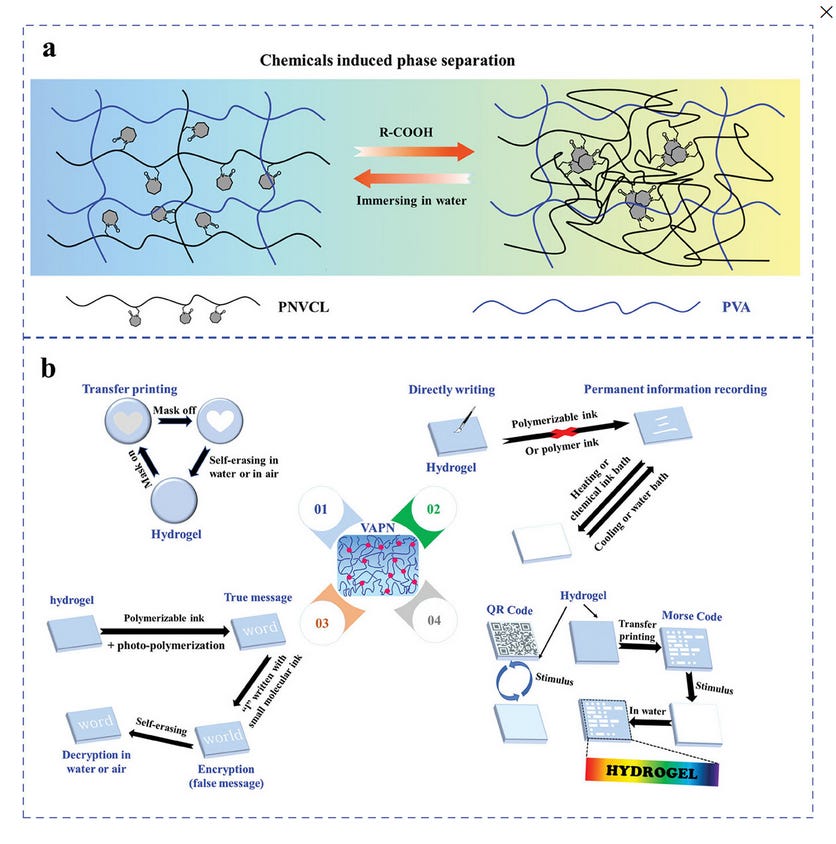
a) Schematic illustration of chemical ink-induced phase separation in composite VAPN hydrogel. b) Schematic summarizing the diverse array of applications of paper-like VAPN hydrogel for information storage, coding, encryption, and decryption (information self-erasing written by small-molecule ink, permanent information recording using polymer ink, information encryption by combined use of small-molecule and polymer inks, and information coding by More Code). (Reprinted with permission by Wiley-VCH Verlag)
To explain, Clifford calls the hydrogel filaments we see now in the blood CDB ( Morgellons) – whatever you want to call them, this is their chemical signature isolated from C19 unvaccinated blood exposed to shedding and environmental contamination. They contain these hydrogel plastics – polyenes (polyethylene glycol), vinyl ( polyvinyl alcohol), polyamide proteins ( nylon, kevlar, (spider)silk proteins that misfold and can create amyloids and prion like precipitates). Additional nanotechnology signatures are silicone, sulfur. The technology hijacks methyl groups, which are needed to detoxify and create Glutathione in the body. It also contains Halogens like Iodine, Bromide, Fluoride, Chlorine.

Polyvinyl alcohol is plastic. It is also mentioned as one of the stealth nanoparticles in the Moderna patent for lipid nanoparticle composition. The other composite of this special hydrogel is polycaprolacton. That is also found in this Moderna patent as a stealth nanoparticle. This suggests that the stealth lipid nano particle technology of the C19 bioweapon has the composite ingredients to have this hydrogel encryption possibility in over 5 Billion C19 injected humans for the achievement of the brain computer interface.

The point that I am making in this article, that the very hydrogels that we find in the blood are known to be programmable and the information can be encrypted. This technology not only tattoos the information into the hydrogel, but can store memories and visual information. Hence it can act like a brain storage. This sounds like digital ID to me:
With further development, materials like these could form the basis of “smart packages” for secure information storage and transfer in logistics, financial transactions or medical treatments.
____________________________________________________________________________
Hydrogel platform enables versatile data encryption and decryption
Hydrogels are crosslinked polymer networks that can absorb huge volumes of water. In recent years, significant progress has been made with so-called “stimuli-responsive” hydrogels – materials that change properties in response to environmental triggers like pH or temperature shifts. Clever integration of these dynamics has enabled hydrogel innovations ranging from drug delivery devices to tissue scaffolds. It turns out such “smart” gels also hold intriguing potential for securely hiding and revealing information – a talent akin to high-tech invisible ink. By leveraging transparency shifts in the materials, researchers recognized hydrogels could be tuned to obscure patterns, images and other visual data imprinted within the gel matrix. Later application of the proper stimulus reveals the concealed information. However, achieving a hydrogel with the sophistication to excel at such data encryption and decryption has remained beyond reach. Formidable technical barriers span from poor pattern resolution due to shrinkage during transparency shifts to slow responsiveness requiring unwieldy stimuli like extreme pH changes. Now, as detailed in a recent paper published in Advanced Functional Materials (“A Paper-Like Hydrogel for Versatile Information Encryption and Decryption Via Chemical-Induced Phase Separation”), researchers have developed a smart hydrogel platform with unprecedented versatility for the secure recording and storage of confidential visual information.
By leveraging hydrogen bonding between two polymer constituents, the research team achieved a paper-like “smart” material with stunning performance. Chemical inks induce rapid, localized phase separation for high-fidelity information storage. Separate thermal triggers then dynamically encrypt the data. Such capabilities far surpass existing hydrogels explored for encryption tasks. The lead author, Yue Zhao of Université de Sherbrooke, remarked: “The precision and tunability of our system sets a new standard in dynamic hydrogel information storage. We foresee diverse anti-counterfeiting and logistics applications.” At the heart of this innovation lies a composite hydrogel comprised of poly(vinyl alcohol) (PVA) and poly(n-vinylcaprolactam) (PNVCL). The researchers cleverly leverage the properties of both polymers: while the PVA forms a mechanically robust network via hydrogen bonding, the PNVCL allows for chemical-induced phase separation through interactions with various ink molecules. Remarkably, when written on with an ink containing carboxylic acids (-COOH groups), the hydrogel locally transitions from transparent to opaque. This effect stems from hydrogen bonding and n-π orbital interactions between the ink molecules and PNVCL, disrupting the equilibrium state of the hydrogel network. The opaque patterns effectively store the “written” information. Unlike other hydrogels, however, this composite system maintains its structural integrity without problematic shrinkage. Minimal volume changes during phase transition allow for excellent pattern resolution. The researchers demonstrated the versatility of this approach by writing with small molecule inks like citric acid or more permanent, macromolecular inks like poly(acrylic acid). The choice of ink determines the encoded information’s longevity within the hydrogel. Perhaps most notable is the simplicity by which the stored messages or images can be hidden and revealed on demand. Taking advantage of the hydrogel’s thermosresponsive properties, the researchers showed how gentle heating can induce a separate phase change that conceals written patterns throughout the material. Later, cooling unveils the secreted data. Through clever combination of multiple phase change mechanisms, many modalities of information encryption and decryption are possible. The lead author, Yue Zhao of Université de Sherbrooke, commented on the significance of this work: “Our hydrogel design principle has opened many new possibilities for information storage and anti-counterfeiting technologies. The versatility of our approach, enabling many modes of encryption/decryption combined with high pattern resolution and fidelity, could inspire next-generation ‘smart’ hydrogels.” Moving forward, Zhao’s team aims to expand the functionality of their platform. Ongoing studies are exploring how chemical affinity differences in similar composite hydrogels may enable applications like solvent-based memories, sensors and drug delivery systems. With further development, materials like these could form the basis of “smart packages” for secure information storage and transfer in logistics, financial transactions or medical treatments. Though still in early stages, this research highlights the promising role that responsive hydrogels may play in ever-advancing data encryption and anti-counterfeiting technologies. Professor Zhao concluded: “Our fundamental studies continue uncovering design principles that improve the real-world usefulness of soft ‘smart’ materials across many fields, contributing to technologies that better society.”
Read the rest of her report here.